For achieving inclusive growth there is a critical need to rethink the role of the State. The early debate among economists about the size of the Government can be misleading. The need of the hour is to have an enabling Government. India is too large and complex a nation for the State to be able to deliver all that is needed. Asking the Government to produce all the essential goods, create all the necessary jobs, and keep a curb on the prices of all goods is to lead to a large cumbersome bureaucracy and widespread corruption.
The aim must be to stay with the objective of inclusive growth that was laid down by the founding fathers of the nation and also to take a more modern view of what the State can realistically deliver.
This is what leads to the idea of an enabling State, that is, a Government that does not try to directly deliver to the citizens everything that they need. Instead, it (1) creates an enabling ethos for the market so that individual enterprise can flourish and citizens can, for the most part, provide for the needs of one another, and (2) steps in to help those who do not manage to do well for themselves, for there will always be individuals, no matter what the system, who need support and help. Hence we need a Government that, when it comes to the market, sets effective, incentive-compatible rules and remains on the sidelines with minimal interference, and, at the same time, plays an important role in directly helping the poor by ensuring that they get basic education and health services and receive adequate nutrition and food.
According to the passage :
1. The objective of inclusive growth was laid down by the founding fathers of the nation.
2. Need of the hour is to have an enabling Government.
3. The Government should engage in maximum interference in market processes.
4. There is a need to change the size of the Government.
Which of the statements given above are correct ?
For achieving inclusive growth there is a critical need to rethink the role of the State. The early debate among economists about the size of the Government can be misleading. The need of the hour is to have an enabling Government. India is too large and complex a nation for the State to be able to deliver all that is needed. Asking the Government to produce all the essential goods, create all the necessary jobs, and keep a curb on the prices of all goods is to lead to a large cumbersome bureaucracy and widespread corruption.
The aim must be to stay with the objective of inclusive growth that was laid down by the founding fathers of the nation and also to take a more modern view of what the State can realistically deliver.
This is what leads to the idea of an enabling State, that is, a Government that does not try to directly deliver to the citizens everything that they need. Instead, it (1) creates an enabling ethos for the market so that individual enterprise can flourish and citizens can, for the most part, provide for the needs of one another, and (2) steps in to help those who do not manage to do well for themselves, for there will always be individuals, no matter what the system, who need support and help. Hence we need a Government that, when it comes to the market, sets effective, incentive-compatible rules and remains on the sidelines with minimal interference, and, at the same time, plays an important role in directly helping the poor by ensuring that they get basic education and health services and receive adequate nutrition and food.
According to the passage, the strategy of inclusive growth can be effected by focussing on
For achieving inclusive growth there is a critical need to rethink the role of the State. The early debate among economists about the size of the Government can be misleading. The need of the hour is to have an enabling Government. India is too large and complex a nation for the State to be able to deliver all that is needed. Asking the Government to produce all the essential goods, create all the necessary jobs, and keep a curb on the prices of all goods is to lead to a large cumbersome bureaucracy and widespread corruption.
The aim must be to stay with the objective of inclusive growth that was laid down by the founding fathers of the nation and also to take a more modern view of what the State can realistically deliver.
This is what leads to the idea of an enabling State, that is, a Government that does not try to directly deliver to the citizens everything that they need. Instead, it (1) creates an enabling ethos for the market so that individual enterprise can flourish and citizens can, for the most part, provide for the needs of one another, and (2) steps in to help those who do not manage to do well for themselves, for there will always be individuals, no matter what the system, who need support and help. Hence we need a Government that, when it comes to the market, sets effective, incentive-compatible rules and remains on the sidelines with minimal interference, and, at the same time, plays an important role in directly helping the poor by ensuring that they get basic education and health services and receive adequate nutrition and food.
What constitutes an enabling Government ?
1. A large bureaucracy.
2. Implementation of welfare programmes through representatives.
3. Creating an ethos that helps individual enterprise.
4. Providing resources to those who are underprivileged.
5. Offering direct help to the poor regarding basic services.
Select the correct answer from the codes given below :
For achieving inclusive growth there is a critical need to rethink the role of the State. The early debate among economists about the size of the Government can be misleading. The need of the hour is to have an enabling Government. India is too large and complex a nation for the State to be able to deliver all that is needed. Asking the Government to produce all the essential goods, create all the necessary jobs, and keep a curb on the prices of all goods is to lead to a large cumbersome bureaucracy and widespread corruption.
The aim must be to stay with the objective of inclusive growth that was laid down by the founding fathers of the nation and also to take a more modern view of what the State can realistically deliver.
This is what leads to the idea of an enabling State, that is, a Government that does not try to directly deliver to the citizens everything that they need. Instead, it (1) creates an enabling ethos for the market so that individual enterprise can flourish and citizens can, for the most part, provide for the needs of one another, and (2) steps in to help those who do not manage to do well for themselves, for there will always be individuals, no matter what the system, who need support and help. Hence we need a Government that, when it comes to the market, sets effective, incentive-compatible rules and remains on the sidelines with minimal interference, and, at the same time, plays an important role in directly helping the poor by ensuring that they get basic education and health services and receive adequate nutrition and food.
Why is the State unable to deliver "all that is needed" ?
1. It does not have sufficient bureaucracy.
2. It does not promote inclusive growth.
Select the correct answer from the codes given below :
For achieving inclusive growth there is a critical need to rethink the role of the State. The early debate among economists about the size of the Government can be misleading. The need of the hour is to have an enabling Government. India is too large and complex a nation for the State to be able to deliver all that is needed. Asking the Government to produce all the essential goods, create all the necessary jobs, and keep a curb on the prices of all goods is to lead to a large cumbersome bureaucracy and widespread corruption.
The aim must be to stay with the objective of inclusive growth that was laid down by the founding fathers of the nation and also to take a more modern view of what the State can realistically deliver.
This is what leads to the idea of an enabling State, that is, a Government that does not try to directly deliver to the citizens everything that they need. Instead, it (1) creates an enabling ethos for the market so that individual enterprise can flourish and citizens can, for the most part, provide for the needs of one another, and (2) steps in to help those who do not manage to do well for themselves, for there will always be individuals, no matter what the system, who need support and help. Hence we need a Government that, when it comes to the market, sets effective, incentive-compatible rules and remains on the sidelines with minimal interference, and, at the same time, plays an important role in directly helping the poor by ensuring that they get basic education and health services and receive adequate nutrition and food.
What is the essential message being conveyed by the author of the passage ?
The concept of 'creative society' refers to a phase of development of a society in which a large number of potential contradictions become articulate and active. This is most evident when oppressed social groups get politically mobilised and demand their rights. The upsurge of the peasants and tribals, the movements for regional autonomy and self-determination, the environmental movements, and the women's movements in the developing countries are signs of emergence of creative society in contemporary times. The forms of social movements and their intensity may vary from country to country and place to place within a country. But the very presence of movements for social transformation in various spheres of a society indicates the emergence of a creative society in a country.
What does the author imply by "creative society" ?
1. A society where diverse art forms and literary writings seek incentive.
2. A society where social inequalities are accepted as the norm.
3. A society where a large number of contradictions are recognised.
4. A society where the exploited and the oppressed groups grow conscious of their human rights and upliftment.
Select the correct answer using the codes given below :
The concept of 'creative society' refers to a phase of development of a society in which a large number of potential contradictions become articulate and active. This is most evident when oppressed social groups get politically mobilised and demand their rights. The upsurge of the peasants and tribals, the movements for regional autonomy and self-determination, the environmental movements, and the women's movements in the developing countries are signs of emergence of creative society in contemporary times. The forms of social movements and their intensity may vary from country to country and place to place within a country. But the very presence of movements for social transformation in various spheres of a society indicates the emergence of a creative society in a country.
What according to the passage are the manifestations of social movements ?
1. Aggressiveness and being incendiary.
2. Instigation by external forces.
3. Quest for social equality and individual freedom.
4. Urge for granting privileges and self-respect to disparaged sections of the society.
Select the correct answer using the codes given below :
The concept of 'creative society' refers to a phase of development of a society in which a large number of potential contradictions become articulate and active. This is most evident when oppressed social groups get politically mobilised and demand their rights. The upsurge of the peasants and tribals, the movements for regional autonomy and self-determination, the environmental movements, and the women's movements in the developing countries are signs of emergence of creative society in contemporary times. The forms of social movements and their intensity may vary from country to country and place to place within a country. But the very presence of movements for social transformation in various spheres of a society indicates the emergence of a creative society in a country.
With reference to the passage, consider the following statements :
1. To be a creative society it is essential to have a variety of social movements.
2. To be a creative society, it is imperative to have potential contradictions and conflicts.
Which of the statements given above is/are correct ?
Consider the following three statements :
1. Only students can participate in the race.
2. Some participants in the race are girls.
3. All girl participants in the race are invited for coaching.
Which one of the following conclusions can be drawn from the above statements ?
Each of the following two items consists of four statements. Of these four statements, two cannot both be true, but both can be false. Study the statements carefully and identify the two that satisfy the above condition. Select the correct answer using the codes given below each set of statements :
Examine the following statements :
1. All animals are carnivorous.
2. Some animals are not carnivorous.
3. Animals are not carnivorous.
4. Some animals are carnivorous.
Codes :
Each of the following two items consists of four statements. Of these four statements, two cannot both be true, but both can be false. Study the statements carefully and identify the two that satisfy the above condition. Select the correct answer using the codes given below each set of statements :
Examine the following statements :
1. All trains are run by diesel engine.
2. Some trains are run by diesel engine.
3. No train is run by diesel engine.
4. Some trains are not run by diesel engine.
Codes :
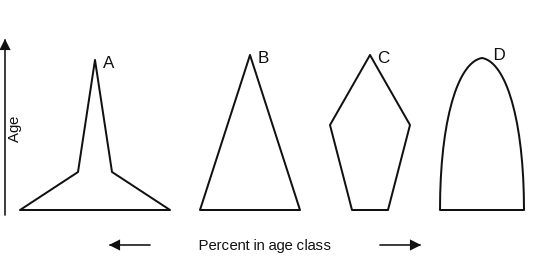
Consider the four age pyramids given below namely A, B, C and D representing four different countries.Which one of them indicates the declining population?
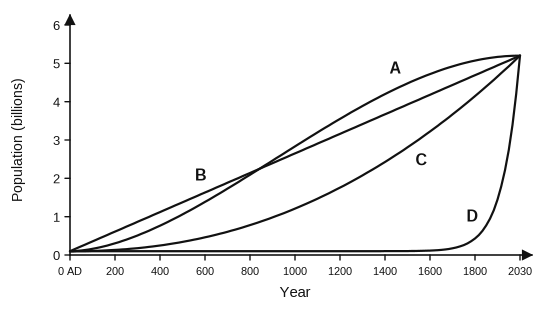
The following figure has four curves namely A, B, C and D. Study the figure and answer the item that follows.Which curve indicates the exponential growth?
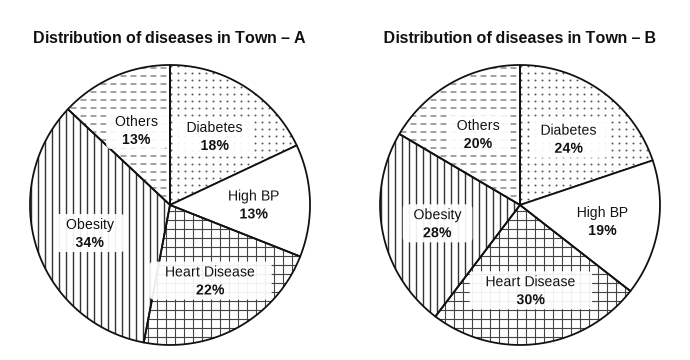
The following pie charts show the break up of disease categories recorded in the patients from two towns, Town A and Town B. Pie charts plot the disease categories as percentage of the total number of patients. Based on these, answer the two items that follow the charts.
Which of the two towns has a higher number of persons with Diabetes?
The following pie charts show the break up of disease categories recorded in the patients from two towns, Town A and Town B. Pie charts plot the disease categories as percentage of the total number of patients. Based on these, answer the two items that follow the charts.
What can we say about persons with more than one disease from these graphs?
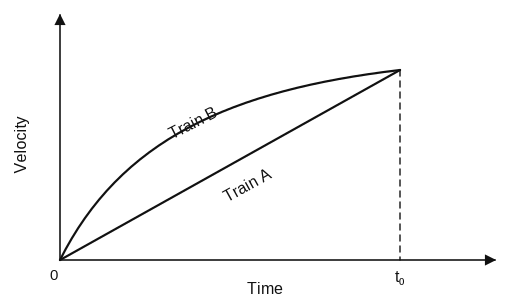
Consider the following Velocity - Time graph. It shows two trains starting simultaneously on parallel tracks.With reference to the above graph, which one of the following statements is not correct?
Ecosystems provide people with a variety of goods and services; food, clean water, clean air, flood control, soil stabilization, pollination, climate regulation, spiritual fulfilment and aesthetic enjoyment, to name just a few. Most of these benefits either are irreplaceable or the technology necessary to replace them is prohibitively expensive. For example, potable fresh water can be provided by desalinating sea-water, but only at great cost.
The rapidly expanding human population has greatly modified the Earth's ecosystems to meet their increased requirements of some of the goods and services, particularly food, fresh water, timber, fibre and fuel. These modifications have contributed substantially to human well being and economic development. The benefits have not been equally distributed. Some people have actually been harmed by these changes. Moreover, short term increases in some ecosystem goods and services have come at the cost of the long-term degradation of others. For example, efforts to increase the production of food and fibre have decreased the ability of some ecosystems to provide clean water, regulate flooding and support biodiversity.
With reference to the passage, consider the following statements.
Expanding human population has an adverse effect on :
1. Spiritual fulfilment
2. Aesthetic enjoyment
3. Potable fresh water
4. Production of food and fibre
5. Biodiversity
Which of the statements given above are correct ?
Ecosystems provide people with a variety of goods and services; food, clean water, clean air, flood control, soil stabilization, pollination, climate regulation, spiritual fulfilment and aesthetic enjoyment, to name just a few. Most of these benefits either are irreplaceable or the technology necessary to replace them is prohibitively expensive. For example, potable fresh water can be provided by desalinating sea-water, but only at great cost.
The rapidly expanding human population has greatly modified the Earth's ecosystems to meet their increased requirements of some of the goods and services, particularly food, fresh water, timber, fibre and fuel. These modifications have contributed substantially to human well being and economic development. The benefits have not been equally distributed. Some people have actually been harmed by these changes. Moreover, short term increases in some ecosystem goods and services have come at the cost of the long-term degradation of others. For example, efforts to increase the production of food and fibre have decreased the ability of some ecosystems to provide clean water, regulate flooding and support biodiversity.
The passage mentions that "some people have actually been harmed by these changes". What does it imply ?
1. The rapid expansion of population has adversely affected some people.
2. Sufficient efforts have not been made to increase the production of food and fibre.
3. In the short term some people may be harmed, but in the long term everyone will benefit from modifications in the Earth's ecosystems.
Which of the statements given above is/are correct ?
Ecosystems provide people with a variety of goods and services; food, clean water, clean air, flood control, soil stabilization, pollination, climate regulation, spiritual fulfilment and aesthetic enjoyment, to name just a few. Most of these benefits either are irreplaceable or the technology necessary to replace them is prohibitively expensive. For example, potable fresh water can be provided by desalinating sea-water, but only at great cost.
The rapidly expanding human population has greatly modified the Earth's ecosystems to meet their increased requirements of some of the goods and services, particularly food, fresh water, timber, fibre and fuel. These modifications have contributed substantially to human well being and economic development. The benefits have not been equally distributed. Some people have actually been harmed by these changes. Moreover, short term increases in some ecosystem goods and services have come at the cost of the long-term degradation of others. For example, efforts to increase the production of food and fibre have decreased the ability of some ecosystems to provide clean water, regulate flooding and support biodiversity.
With reference to the passage, consider the following statements :
1. It is imperative to modify the Earth's ecosystems for the well being of mankind.
2. Technology can never replace all the goods and services provided by ecosystems.
Which of the statements given above is/are correct ?
A moral act must be our own act; must spring from our own will. If we act mechanically, there is no moral content in our act. Such action would be moral, if we think it proper to act like a machine and do so. For, in doing so, we use our discrimination. We should bear in mind the distinction between acting mechanically and acting intentionally. It may be moral of a king to pardon a culprit. But the messenger carrying out the order of pardon plays only a mechanical part in the king's moral act. But if the messenger were to carry out the king's order considering it to be his duty, his action would be a moral one. How can a man understand morality who does not use his own intelligence and power of thought, but lets himself be swept along like a log of wood by a current ? Sometimes a man defies convention and acts on his own with a view to absolute good.
Which of the following statements best describe/describes the thought of the writer ?
1. A moral act calls for using our discretion.
2. Man should react to a situation immediately.
3. Man must do his duty.
4. Man should be able to defy convention in order to be moral.
Select the correct answer from the codes given below :
A moral act must be our own act; must spring from our own will. If we act mechanically, there is no moral content in our act. Such action would be moral, if we think it proper to act like a machine and do so. For, in doing so, we use our discrimination. We should bear in mind the distinction between acting mechanically and acting intentionally. It may be moral of a king to pardon a culprit. But the messenger carrying out the order of pardon plays only a mechanical part in the king's moral act. But if the messenger were to carry out the king's order considering it to be his duty, his action would be a moral one. How can a man understand morality who does not use his own intelligence and power of thought, but lets himself be swept along like a log of wood by a current ? Sometimes a man defies convention and acts on his own with a view to absolute good.
Which of the following statements is the nearest definition of moral action, according to the writer ?
A moral act must be our own act; must spring from our own will. If we act mechanically, there is no moral content in our act. Such action would be moral, if we think it proper to act like a machine and do so. For, in doing so, we use our discrimination. We should bear in mind the distinction between acting mechanically and acting intentionally. It may be moral of a king to pardon a culprit. But the messenger carrying out the order of pardon plays only a mechanical part in the king's moral act. But if the messenger were to carry out the king's order considering it to be his duty, his action would be a moral one. How can a man understand morality who does not use his own intelligence and power of thought, but lets himself be swept along like a log of wood by a current ? Sometimes a man defies convention and acts on his own with a view to absolute good.
The passage contains a statement "lets himself be swept along like a log of wood by a current." Among the following statements, which is/are nearest in meaning to this ?
1. A person does not use his own reason.
2. He is susceptible to influence/pressure.
3. He cannot withstand difficulties/challenges.
4. He is like a log of wood.
Select the correct answer using the codes given below :
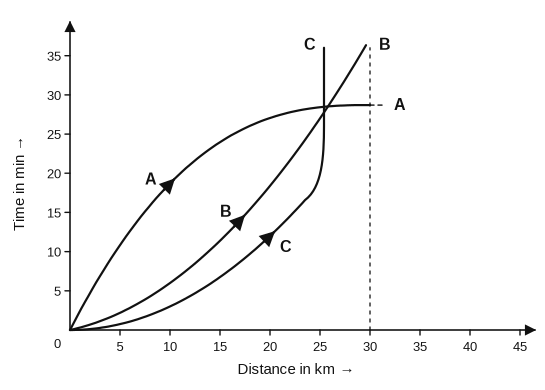
Consider the following distance - time graph. The graph shows three athletes A, B and C running side by side for a 30 km race.With reference to the above graph, consider the following statements :
1. The race was won by A.
2. B was ahead of A up to 25 km mark.
3. C ran very slowly from the beginning.
Which of the statements given above is/are correct?
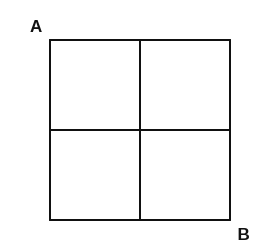
Study the following figure :
A person goes from A to B always moving to the right or downwards along the lines. How many different routes can he adopt?Select the correct answer from the codes given below :